I am currently a PhD student at Heriot Watt and is progressing with my research. My research question is:
How can children’s literature be used to develop hearing parents’ understanding of their deaf* child’s experience?
With the sub questions of:
- How are deaf characters represented in children’s picture books?
- What narratives are deaf characters included in?
- Can hearing parents learn about their child’s deaf experience through picture books?
- Can children’s literature offer a bridge to deafhearing families (those families with deaf and hearing members) between hearing and deaf* culture and language?
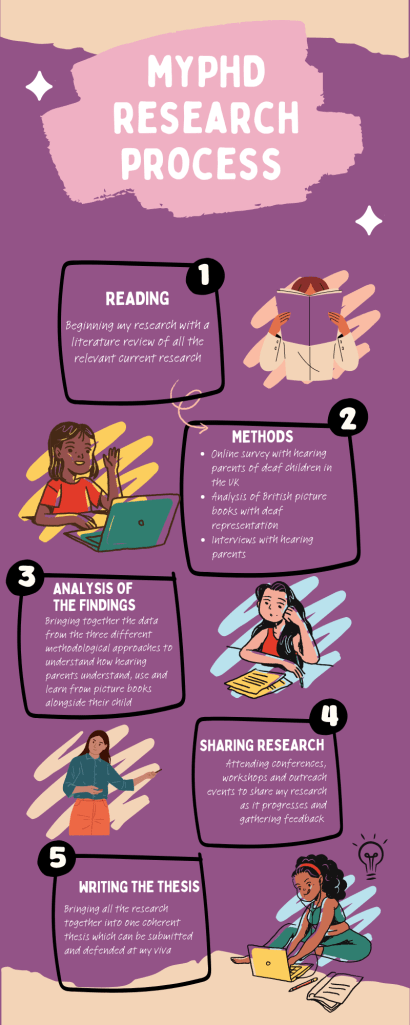
To answer these questions I have reviewed the current relevant research to understand the literature and what others have found so far. I have read around many related topics to help develop my knowledge, understanding and to appropriately frame my research questions and approach.
My research is focused in the UK and draws on the Scottish policy context in terms of the Scottish Government’s policies relating to British Sign Language and children and families. The health care support through NHS new-born hearing screening, audiology support and teachers of the deaf. The availability of BSL classes and educational support.
My first data collection was an online survey. The target sample for the survey was hearing parents who have a deaf or hard of hearing child, aged 10 or younger and who live in the United Kingdom. The aim of the survey was to gather a broad overview of the experiences of hearing parents sharing stories with their deaf or hard of hearing child. This was completed in February 2024.
My second data set is a corpus of children’s picture books with deaf representation. These books are all published in the UK. On the resources page you will find a list of books, not all of these will be used in my research as I am focussing on books that are published between 2010 and 2024.
I have completed a textual thematic analysis of the picture books looking at both the text and illustrations. Through the coding and analysis I identified six themes across the books.
The six themes from the picture book analysis
- Discrimination – examples within the narratives showing the deaf character experiencing bullying, barriers to access, disparaging comments or isolation.
- Deaf character adapts to the hearing world – examples within the narratives where the onus is on the deaf character to assimilate to the deaf environment because there are no other deaf characters or community, the predominant use of speech and relying on hearing for communication, explaining deafness to hearing characters, and narratives that are located within the medical model of disability showing the medical interventions to ‘cure’ deafness.
- Communication methods – this theme break downs the different communication methods of the characters there are examples of speech, BSL (British Sign Language), lip reading, a mixture of these or other types of communication.
- Risk and danger – this theme examines how risks and danger are portrayed in the narratives, whether the deaf character is given agency to take and manage risk or whether this is shown to be unmanageable for the deaf character and requires a hearing characters intervention often in terms of being saved.
- Portrayal of disability – this theme explores the portrayal of deaf characters or any other characters with a disability, whether they have agency, pride, high self-esteem or whether disability is portrayed as a limiting factor in their lives.
- Culturally deaf representation – this theme includes cultural representations of deafness, different ways of interacting in the world as a deaf person, different ways of using other senses, or ways of being independent and considers what is absent in relation to culturally deaf representation.
Over the summer of 2025 I completed five interviews with hearing parents of deaf children under 10 years old. These were be semi-structured interviews and are a rich source of data which I am currently analysing.
The survey data, the picture book and interview analysis will then be triangulated to draw out the overarching themes. I hope that I will be able to make some helpful recommendations for both hearing parents of deaf children and for the publishing sector to consider when they are including deaf characters in their publications.
*deaf is being used to encompass those who are deaf, deafened, hard of hearing, or a deaf user of British Sign Language

